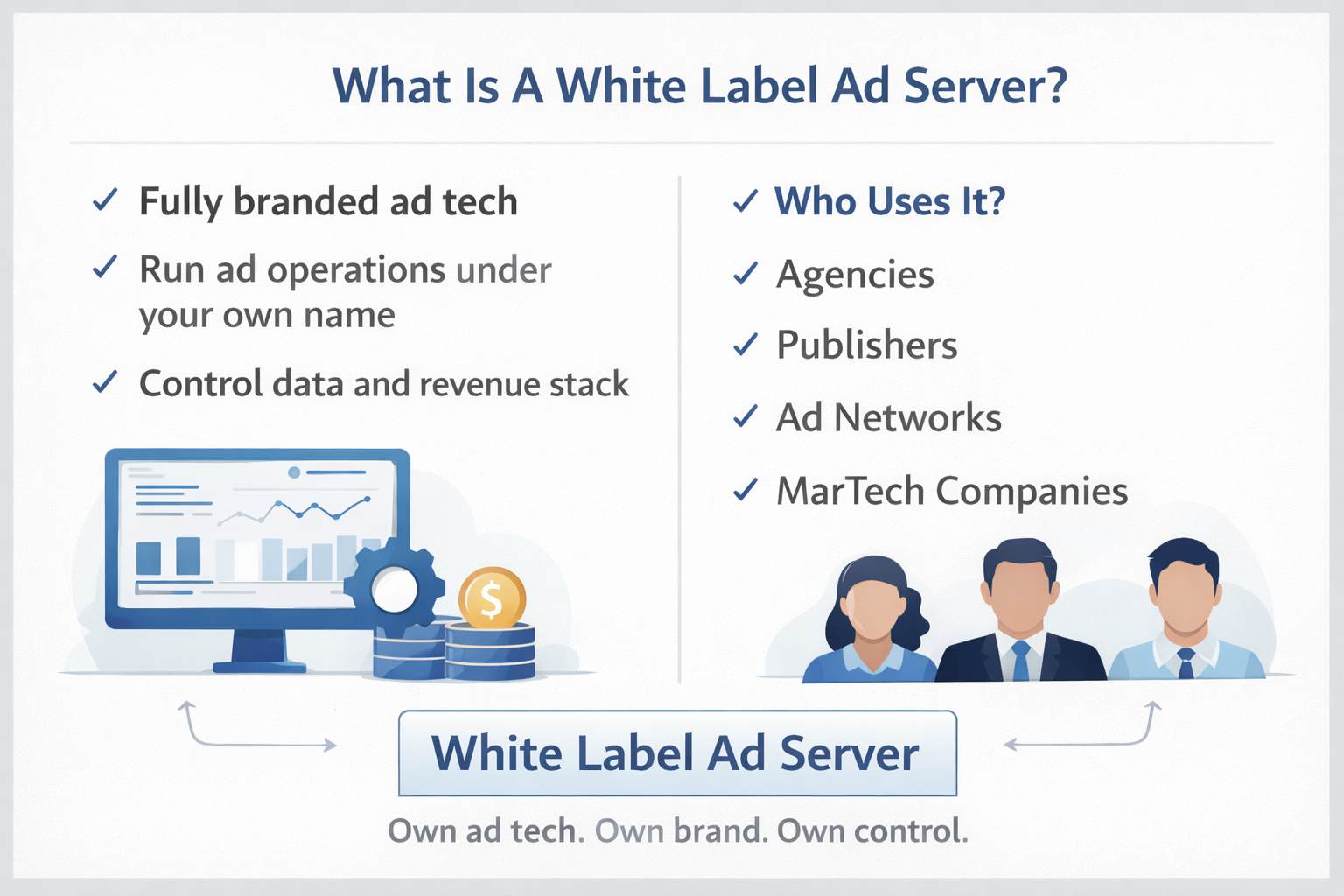
The digital advertising landscape is evolving fast, and for agencies and publishers who want more control, a white label ad server has become a powerful solution. Instead of relying on third-party platforms with limited flexibility, a white label ad server allows you to run advertising operations under your own brand, manage data directly, and scale revenue on your own terms.
Instead of sending your traffic through somebody else’s branded platform, a white label ad server lets you run your own ad technology under your own name. You keep the branding, you manage the data, and you decide how the revenue stack works. Think of it as owning the “engine room” of your ad business rather than renting a single seat on someone else’s ship.
Let’s break down what a white label ad server is, how it works, why agencies and publishers love it, and what you should look for if you are considering making the switch.
What Is A White Label Ad Server?
A white label ad server is a ready‑made advertising technology platform that you can fully brand and operate as if it were your own product. Instead of investing years and a huge development budget building your own ad server from scratch, you license a proven engine and customise the look, feel, and sometimes even the feature set.
In practice, that means:
-
Your logo, colours, and domain appear everywhere your users log in.
-
Your teams and clients see your brand, not the underlying vendor.
-
You can configure ad placements, targeting rules, reporting, and billing in one central place.
It is like buying a high‑performance car chassis and then designing the body, interior, and dashboard the way you want. Underneath, the tech is robust and tested; on the surface, it is distinctly yours.
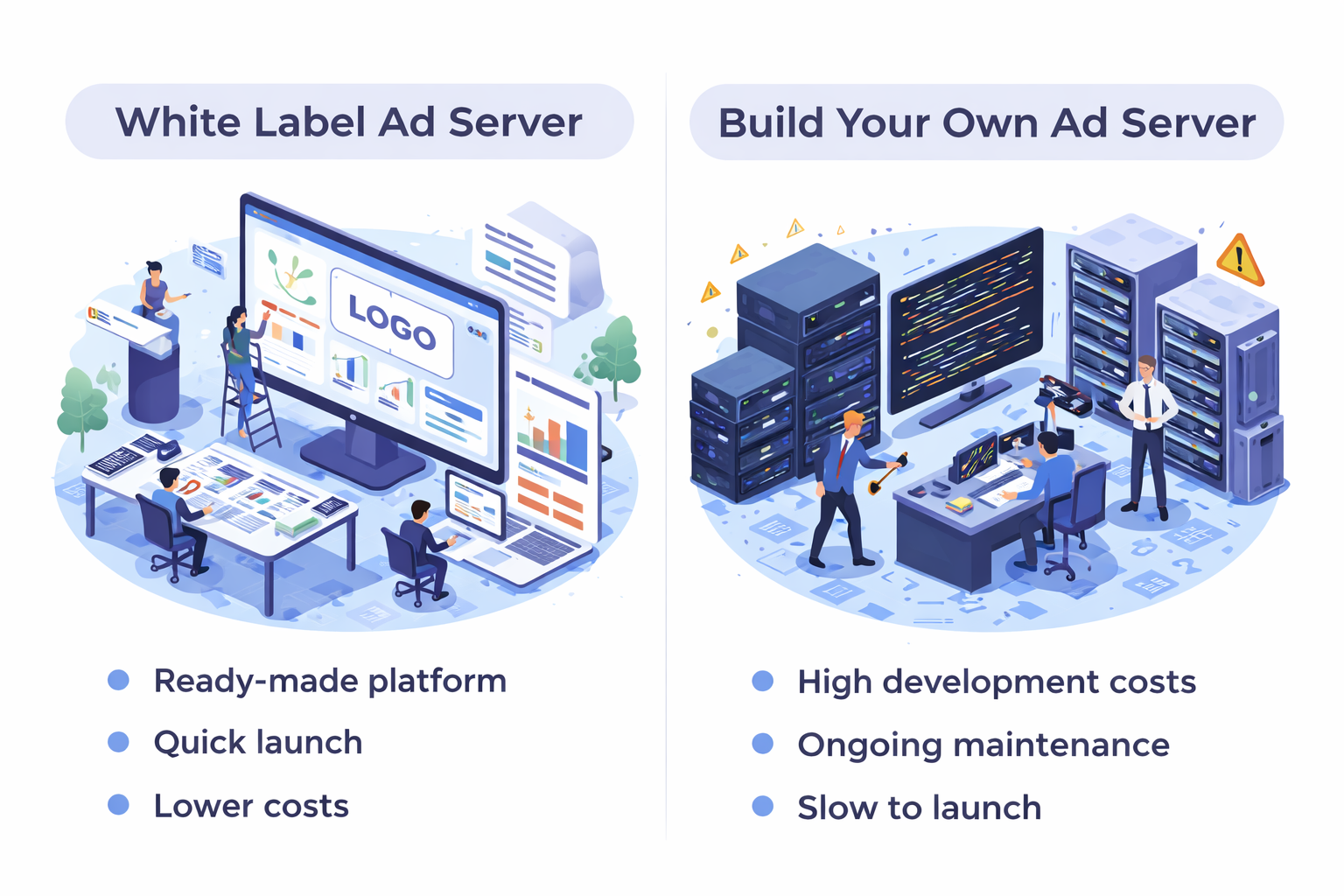
Why White Label Instead Of Building Your Own?
You might wonder, “Why not just build our own ad server?” On paper, it sounds great. In reality, it is a long, expensive, and risky project.
To build an ad server in‑house, you would need:
-
Engineers who understand real‑time bidding, ad delivery, and scaling.
-
Ongoing maintenance to stay compliant with privacy laws and browser changes.
-
Constant updates to handle new formats (CTV, in‑app, native, video, etc.).
A white label solution shortcuts all of that. You are effectively renting a battle‑tested engine, then layering your own business model and client relationships on top. It is faster to launch, easier to maintain, and usually far more cost‑effective than reinventing the wheel.
How A White Label Ad Server Works (In Plain English)
The tech behind an ad server can get pretty deep, but the basic flow is simple when you look at it from a user’s point of view.
-
A user visits a website, opens an app, or streams content where an ad slot exists.
-
The ad server receives a request: “We have an impression available—who wants it?”
-
The server checks targeting rules, campaigns, priorities, and any demand sources (direct deals, networks, programmatic partners).
-
It selects the best matching ad according to the rules you set—price, relevance, pacing, frequency caps, and more.
-
The ad is delivered to the user almost instantly, and the impression is logged for reporting and billing.
With a white label setup, all of that happens under your brand and control. From dashboards and reports to login URLs, everything looks and feels like your own proprietary ad platform.
Who Uses White Label Ad Servers?
White label ad servers are popular across several types of businesses. If you recognise yourself in any of these, it might be worth seriously considering one.
-
Digital marketing agencies
Agencies that manage campaigns for multiple clients can offer their own “platform” instead of just acting as media buyers. It reinforces their value and helps build stickier long‑term relationships. -
Publishers and media groups
Publishers that own websites, apps, or OTT/CTV inventory use white label ad servers to manage direct deals, house ads, and programmatic demand in one place. -
Ad networks and resellers
Companies that aggregate inventory from multiple publishers and package it for advertisers can use a white label platform as their core technology layer. -
SaaS and MarTech providers
Some marketing platforms integrate ad serving capabilities into their software suite using a white label engine behind the scenes.
In short, if you want to control how ads are sold and served—but do not want to build your own tech stack from the ground up—a white label ad server sits right in your sweet spot.
Key Features To Look For In A White Label Ad Server
Not all platforms are created equal. When you start weighing options, pay attention to specific features that will affect your day‑to‑day operations.
Full branding options: Can you use your own domain (e.g., ads.yourbrand.com)? Is the dashboard fully re‑skinnable with your logo and colour scheme?
Flexible targeting and rules: You will want detailed targeting: geo, device, OS, time, frequency caps, custom segments, and more. The more flexible the rules, the more precise your campaigns.
Support for multiple formats: Display, video, native, in‑app, CTV, DOOH—make sure the platform supports the formats your clients use now and might need later.
Programmatic connectivity: If you plan to plug into SSPs, DSPs, or run header bidding, check whether the platform plays nicely with popular programmatic partners.
Real‑time reporting and APIs:
Detailed, near real‑time analytics are essential for optimisation. APIs allow you to integrate the ad server with your own dashboards or BI tools.
User roles, permissions, and multi‑tenant setup: If you work with multiple clients or publishers, you need granular access control and the ability to segment data cleanly.
Think of it like choosing the right toolbox. If you bring the wrong tools to the job, everything takes longer and hurts more than it should.
Benefits Of Using A White Label Ad Server
So, what do you actually gain beyond a shiny branded interface? Quite a lot.
-
Brand authority and differentiation
Having “your own” ad platform makes you stand out. Instead of saying, “We run your campaigns through X third‑party,” you say, “We run everything through our proprietary platform.” The perception shift alone can be powerful. -
More control over margins
With your own white label ad server, you can structure fees, markups, and value‑add services the way you want. You are not stuck with someone else’s revenue share model. -
Data ownership and visibility
You see performance data at a deeper level and often retain more ownership of how that data is stored and used, subject to privacy laws. -
Scalability
As you bring in more clients, sites, or apps, the platform scales with you. You are not building new infrastructure from scratch—you are configuring what already exists. -
Faster time to market
Instead of spending months or years building, testing, and fixing your own ad tech, you can launch your branded platform in a fraction of the time.
In a crowded market, those advantages can be the difference between being “just another agency” and being the partner whose tech and strategy clients genuinely rely on.
Common Use Cases For White Label Ad Servers
To make it more concrete, here are a few practical scenarios where white label ad serving really shines.
-
Agency running performance campaigns
You manage dozens of performance campaigns across niches. With a white label platform, you centralise tracking, reporting, and optimisation while keeping clients inside your branded portal. -
Publisher with direct deals and programmatic demand
You sell premium placements directly to brands, but also plug into programmatic demand to fill remnant inventory. A white label server lets you control priority, floor prices, and yield in one place. -
Ad network connecting niche publishers to advertisers
You aggregate niche sites (e.g., sports, parenting, finance) and sell targeted packages to advertisers. The white label ad server becomes the hub where all that traffic and demand meets. -
Media company expanding into CTV or in‑app
As you move into connected TV or mobile apps, you need an ad server that handles cross‑platform delivery without juggling multiple detached tools.
Think of the platform as your control tower. The more moving parts in your ad business, the more critical that control tower becomes.
Challenges And Limitations To Keep In Mind
Of course, white label is not a magic wand. There are real challenges to consider before jumping in.
-
Learning curve
Your team needs time to understand the platform, adopt new workflows, and move away from legacy tools. -
Responsibility for configuration
Even though you are not coding the platform, you are responsible for setting it up properly—targeting rules, line items, priorities, tracking, and more. -
Client expectations
When you offer a branded platform, clients may expect a similar level of support and reliability as big global ad tech companies. You need clear SLAs and communication. -
Ongoing optimisation
Ad serving is not “set it and forget it.” Someone must continually monitor performance, test creatives, and refine strategy.
Ignoring these points is like buying a race car and assuming it will win races on its own. You still need skilled drivers and a pit crew.
How To Choose The Right White Label Ad Server
If you are seriously considering a white label solution, here is a simple framework to guide your decision.
-
Clarify your business model
Are you primarily an agency, a publisher, an ad network, or a hybrid? Your model will influence which features are non‑negotiable. -
Define your must‑have features
List your critical needs: formats, integrations, reporting depth, user roles, etc. Separate “must have” from “nice to have.” -
Evaluate demos with real scenarios
Do not just watch generic demos. Ask vendors to walk through examples based on your real campaigns and inventory. -
Check support and documentation
Strong support, onboarding, and documentation can save you countless hours. Make sure they are easy to reach and clear in their explanations. -
Think long term
Look beyond your current state. Will this platform still fit if you double your client base or expand into new channels like CTV and DOOH?
Choosing a white label ad server is closer to choosing a long‑term partner than buying a one‑off tool. Take your time, ask hard questions, and make sure the fit is right.
Practical Steps Before You Launch Your Own White Label Ad Server
Once you have picked a platform, treat the rollout like a mini‑product launch.
-
Map your existing campaigns, clients, and inventory, and plan the migration step by step.
-
Decide how you will present the platform to clients—name, positioning, pricing, onboarding.
-
Train your internal teams first, then invite a small group of “pilot” clients to test the new system.
-
Gather feedback, refine processes, and only then roll it out more broadly.
This phased approach lowers risk and gives you a chance to fine‑tune the experience before everyone is onboard.
Conclusion
A white label ad server gives agencies, publishers, and ad networks a powerful way to take control of their ad tech without building it all from scratch. By putting your own brand on a robust, existing engine, you get the best of both worlds: speed to market and a strong, differentiated offering. You keep the data closer, manage revenue more flexibly, and present clients with a unified, professional platform that feels truly yours.
Is it a silver bullet? No. You still need strategy, skilled people, and a clear understanding of your business model. But if you are serious about growing your ad operations and stepping up from basic third‑party tools, a well‑chosen white label ad server can be a cornerstone of that growth.
Use those pain points as a checklist when you speak to vendors. In the end, the right white label ad server is the one that makes your work easier, your results better, and your clients more confident that they chose the right partner.