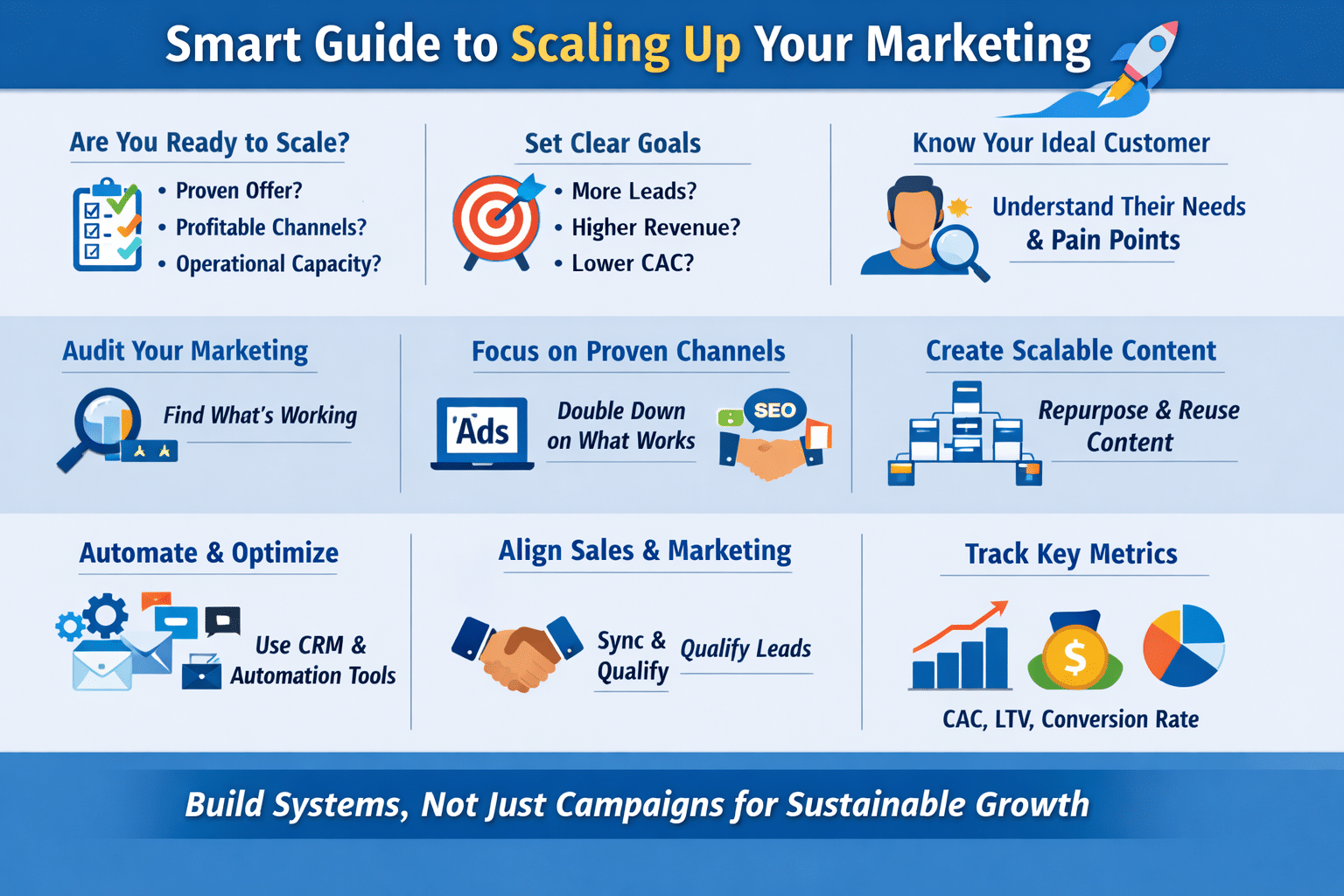
scale up marketing, When people say they want to “scale up marketing,” they usually mean one thing: more leads, more sales, more revenue. But here’s the catch—if your marketing grows faster than your systems, your team, or your budget, things fall apart fast.
Scaling up marketing is not just “doing more campaigns.” It’s about building a system that can handle more traffic, more leads, and more complexity without collapsing. In this guide, we’ll walk through how to scale your marketing in a smart, sustainable way, not just a louder way.
Understand If You’re Ready To Scale
Before you hit the gas, you need to know whether the car can handle the speed.
-
Do you have a clear, proven offer that people already buy?
-
Are some of your marketing channels already working profitably, even at a small scale?
-
Can your operations handle more customers (support, delivery, onboarding)?
-
Do you know your key numbers: CAC, LTV, conversion rate, churn?
If your offer isn’t validated yet, scaling marketing is like pouring water into a bucket full of holes. Fix the bucket first, then increase the flow.
Define Clear Goals Before You Spend
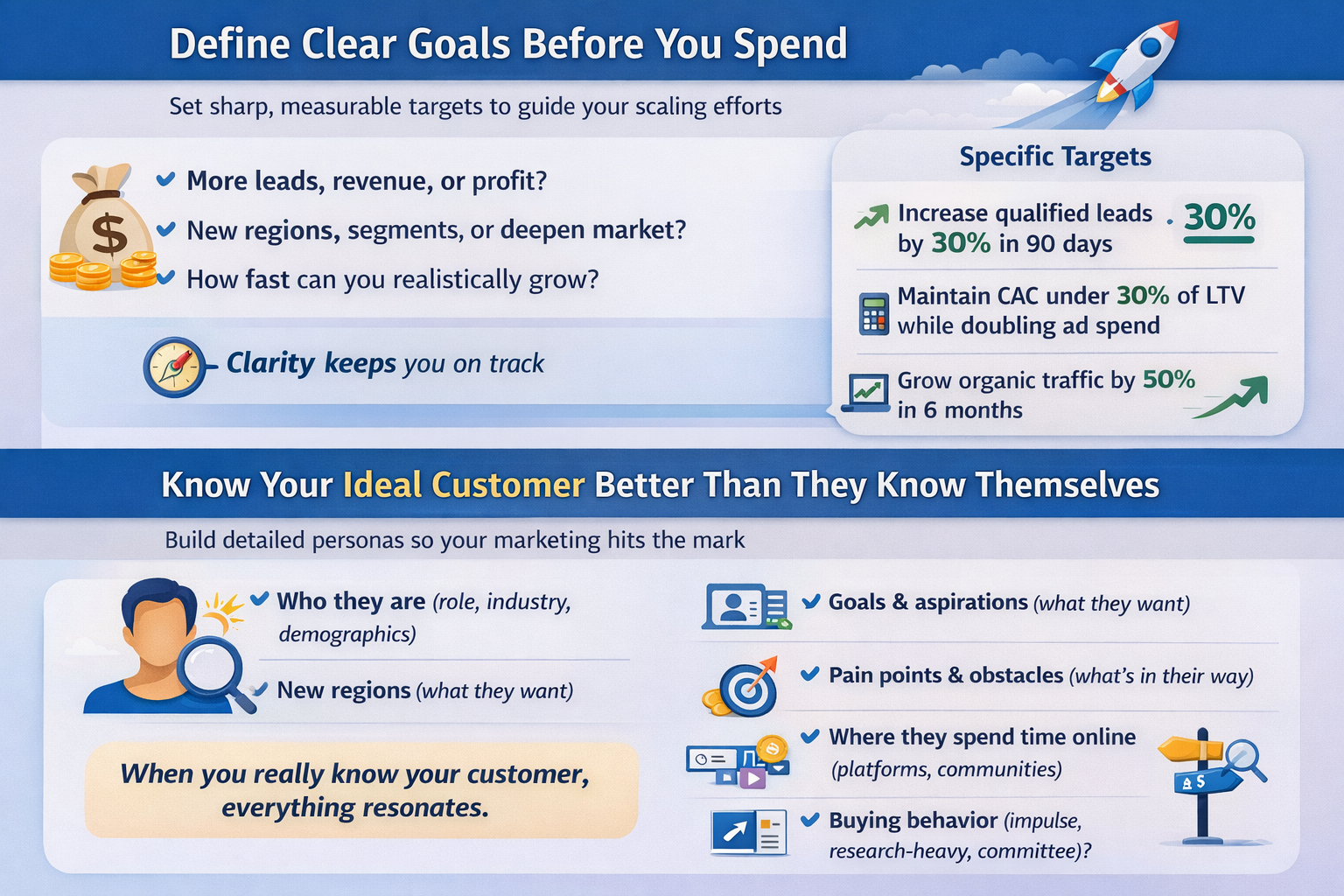
Scaling for the sake of “growth” is vague and dangerous. You need sharp, measurable goals so you can track whether your scaling efforts are actually working.
Ask yourself:
-
Do you want more leads, more revenue, or more profit?
-
Are you aiming to expand to new regions, new segments, or just deepen your current market?
-
How fast do you want to grow—and can your team realistically support that pace?
Turn those into specific targets, for example:
-
Increase qualified leads by 30% in 90 days
-
Maintain CAC under 30% of LTV while doubling ad spend
-
Grow organic traffic by 50% in 6 months
Clarity here becomes your compass. Without it, every new idea looks like a good idea.
Know Your Ideal Customer Better Than They Know Themselves
You can’t scale up marketing if you’re still guessing who you’re talking to.
Build or refine your customer personas:
-
Who are they (role, industry, income, demographics)?
-
What are they trying to achieve (goals, aspirations)?
-
What’s in their way (pain points, fears, obstacles)?
-
Where do they spend time online (social platforms, communities, search)?
-
How do they make buying decisions (impulse, research-heavy, committee)?
Think of this as tuning a radio. If you’re slightly off frequency, people will hear noise. But when you’re locked in on the right station, everything clicks—copy, creatives, landing pages, and offers all resonate.
Audit Your Current Marketing Engine
Scaling up starts with knowing what’s already working—and what’s quietly wasting money.
Look at each channel you’re using right now:
-
Website and SEO
-
Email marketing
-
Social media (organic and paid)
-
Content marketing (blog, video, podcasts)
-
Referrals and partnerships
For each, ask:
-
What’s the cost per lead and cost per acquisition?
-
What’s the conversion rate from click to lead, and lead to customer?
-
How much time and money does this channel consume?
-
Is performance improving, stable, or declining?
You don’t scale everything. You double down on the winners and either fix or drop the losers.
Build A Scalable Marketing Strategy (Not Just Tactics)
Scaling is not about random hacks—it’s about a strategy you can repeat and grow.
Your strategy should cover:
-
Who you’re targeting (priority segments)
-
What core offers you’re promoting
-
Which key channels you’ll scale first
-
What type of content and messaging you’ll lead with
-
How you’ll measure success and adjust
Think of your marketing as a machine with three main pillars:
-
Attract (traffic and attention)
-
Convert (leads and sales)
-
Nurture (relationships and retention)
Scaling means strengthening each pillar so they can all handle more volume, not just pouring more traffic into a weak funnel.
Double Down On Proven Channels First
When scaling, “shiny object syndrome” is your enemy. It’s tempting to chase the newest platform, but the safest way to scale is to start with what already works.
-
If SEO is working, increase content production, improve internal linking, and build more quality backlinks.
-
If paid ads are profitable, gradually raise budgets while tightening your targeting and testing new creatives.
-
If email converts well, grow your list faster and improve automation sequences.
Ask: what channel, if I poured more fuel into it, would give me the fastest, safest return?
Only after your main channels are close to saturation does it make sense to aggressively experiment with new ones.
Create Content That Actually Scales
Content is one of the most powerful tools for scaling because it compounds over time—if you do it right.
Focus on content that:
-
Solves real problems for your audience
-
Answers questions they actually search for
-
Positions your brand as a trusted authority
-
Can be reused and repurposed across formats
For example, one in-depth guide can become:
-
A series of blog posts
-
Several short social posts
-
A YouTube video or webinar
-
Email sequences
-
Slide decks for sales
Think of content as a “content tree”: one strong trunk (pillar content) with many branches (repurposed assets) feeding all your channels.
Use Marketing Automation To Handle Volume
You can’t scale if everything is manual. At some point, your team will hit a wall.
Automation helps you:
-
Nurture leads with email sequences without writing every message in real time
-
Score leads and route them to sales at the right moment
-
Trigger follow-ups based on behavior (clicks, downloads, visits)
-
Maintain consistent communication without burning out your team
Tools like CRM systems, email automation platforms, and marketing suites become your invisible workforce. They don’t replace humans, but they handle the repetitive stuff so your people can focus on strategy and creativity.
Align Sales And Marketing As You Scale
If marketing is generating more leads but sales can’t convert them, you’re not really scaling—you’re just inflating your numbers.
To keep both engines in sync:
-
Agree on what a “qualified lead” really is
-
Share insights: what objections sales is hearing, what content helps close deals
-
Use the same CRM and data definitions
-
Hold regular meetings to review pipeline quality, not just quantity
The tightest growth loops happen when marketing warms up the conversation and sales finishes it smoothly, without confusion or friction.
Track The Right Metrics (And Ignore The Vanity Ones)
More followers, more likes, more impressions—they look good in screenshots, but they don’t pay the bills.
When scaling, focus on metrics that directly affect revenue:
-
Customer acquisition cost (CAC)
-
Lifetime value (LTV)
-
CAC to LTV ratio
-
Lead-to-customer conversion rate
-
Channel-level ROI
-
Churn or repeat purchase rate
Think of your metrics as the dashboard in a car. When you speed up, you need better visibility, not just a louder engine. Data-driven decisions become non‑negotiable at scale.
Test, Learn, And Iterate Relentlessly
Scaling is not a straight line; it’s more like climbing a staircase—you test a step, stabilize, then climb again.
Make experimentation part of your marketing culture:
-
A/B test headlines, images, CTAs, landing page layouts
-
Try new audiences, creative angles, and offers in your best‑performing channels
-
Run controlled experiments so you can actually attribute improvements
The goal isn’t perfection; it’s continuous, incremental improvement. Over time, those tiny gains compound and turn into big advantages.
Avoid Common Pitfalls When Scaling Up Marketing
Many brands hit the same traps when they try to scale:
-
Scaling a broken funnel (you pour in more traffic but conversion stays terrible)
-
Ignoring customer experience (support, delivery, product quality)
-
Chasing too many channels at once and doing all of them poorly
-
Cutting creativity and relying only on budget and brute force
-
Not hiring or training enough people to support the growth
Scaling should feel like controlled acceleration, not a car wobbling at high speed.
Build A Team That Can Grow With You
At a certain stage, tools alone aren’t enough. You need people who can own and grow parts of your marketing engine.
Key roles you may need as you scale:
-
Strategist or marketing lead to set direction
-
Performance marketer for paid channels
-
Content marketer or copywriter
-
SEO specialist
-
Marketing ops / automation specialist
-
Designer or creative lead
You don’t need all of them at once, but you do need clarity on what to outsource, what to hire for, and what to keep in‑house.
Conclusion
Scaling up marketing isn’t about shouting louder; it’s about building a smarter, stronger system. You define clear goals, understand your audience deeply, double down on what already works, and then create processes, content, automation, and teams that can handle more volume without collapsing.
Think of it like building a bigger bridge, not just sending more cars across a weak one. You reinforce the structure, test the load, and then gradually increase the traffic.
When you approach scaling this way, growth becomes predictable instead of chaotic. You stop guessing, start measuring, and create a marketing engine that keeps working even when you’re not watching it every minute.