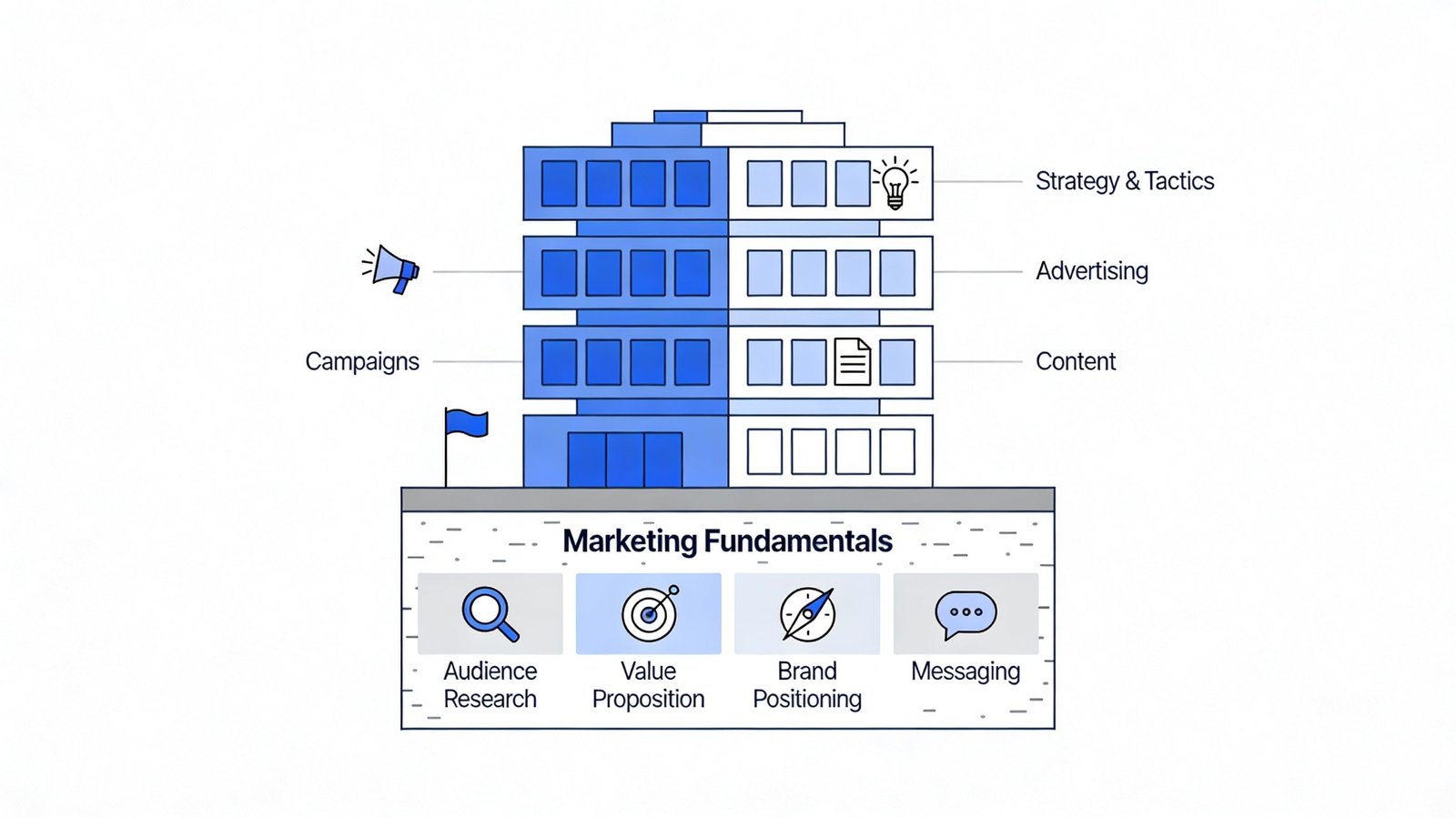
Marketing Fundamentals today moves fast, but the brands that win long term are usually the ones that stay rooted in the basics. When you understand the fundamentals, every campaign, piece of content, and ad starts to feel less like a gamble and more like a calculated move. Think of marketing fundamentals as the blueprint for your entire growth engine: ignore them and you are building on sand, respect them and you build something that actually lasts.
What Are Marketing Fundamentals in Modern Business?
At its core, marketing is about understanding people, creating value for them, and communicating that value clearly so they feel confident choosing you. Fundamentals are the set of principles that guide how you do this consistently, no matter what’s trending this year.
These fundamentals help you:
-
Know who you are talking to and what they really need, not what you assume they need.
-
Craft offers that solve specific problems or deliver real benefits.
-
Communicate in a way that builds trust instead of confusion or pressure.
When you stick to these basics, your strategy stops being random tactics and becomes a repeatable system for growth.
The True Purpose of Marketing Fundamentals
Strip away the jargon and marketing is simply connecting the right offer with the right people at the right time. Value only matters when someone actually experiences it, so your job is to bridge that gap.
A strong marketing approach helps you:
-
Explain what you offer in simple, benefit-led language.
-
Build trust with clear, honest, and consistent messages.
-
Guide people toward a decision they feel good about making.
Done properly, marketing deepens relationships with customers and creates growth driven by genuine interest, not pushy tactics or constant discounts.
Why Market Research Is a Core Marketing Fundamental
Guesswork is the fastest way to burn your budget. Research is how you swap assumptions for facts. It helps you see what people actually do, not just what you hope they do.
Strong market research lets you:
-
Discover what your audience values, fears, and desires.
-
Spot gaps or underserved segments in the market before competitors do.
-
Test ideas on a small scale before you invest heavily.
Think of research as your map: without it, even a great product can get lost.
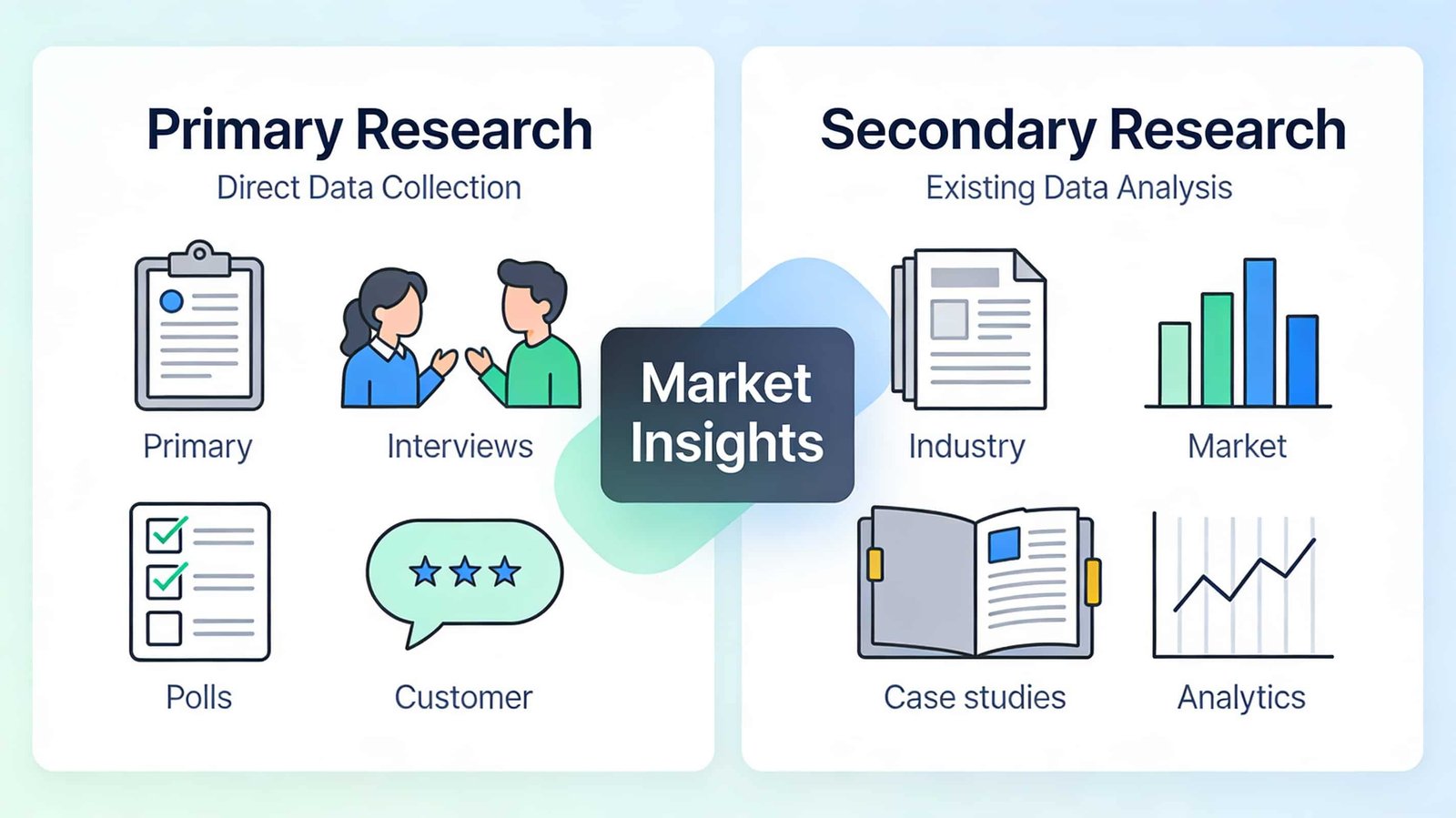
Primary vs Secondary Research in Marketing Fundamentals
Both primary and secondary research are essential, but they serve different purposes.
-
Primary research
-
Comes directly from your target audience via surveys, interviews, polls, feedback forms, or usability tests.
-
Helps you answer specific questions like “Why did you cancel?” or “What nearly stopped you from buying?”.
-
-
Secondary research
-
Uses existing data from industry reports, case studies, government data, and reputable publications.
-
Helps you understand market size, trends, benchmarks, and general behavior patterns.
-
Use secondary research to get the big picture, then primary research to zoom in on your exact customers.
Competitor Analysis as a Key Marketing Fundamental
Your competitors quietly reveal what customers already accept, what they ignore, and what they are still waiting for.
A good competitor review helps you:
-
Understand which offers, price points, and messages the market already responds to.
-
Spot weaknesses like poor service, slow delivery, or confusing positioning that you can outperform.
-
Identify trends in features, channels, and content that are gaining traction.
You are not copying them; you are using them as a reference point so you can show up differently and more clearly.
Industry and Trend Insights
No market stays still. Consumer expectations, technologies, and channels constantly evolve. If you ignore trends, you risk becoming the brand that “used to be relevant.”
By tracking your industry and wider digital trends, you can:
-
Adapt your offer, messaging, and channels before declines or disruptions hit.
-
Align with how people actually shop, research, and make decisions today.
-
Plan for shifts like AI-driven personalization, privacy rules, or new content formats.
The fundamentals stay the same, but the way you apply them should flex with the times.
The 7Ps of Marketing Fundamentals Explained
The 7Ps of marketing give you a complete checklist for planning and evaluating your strategy: Product, Price, Place, Promotion, People, Process, and Physical Evidence. Originally there were only 4Ps, but modern marketing expanded the model to reflect service quality and customer experience.
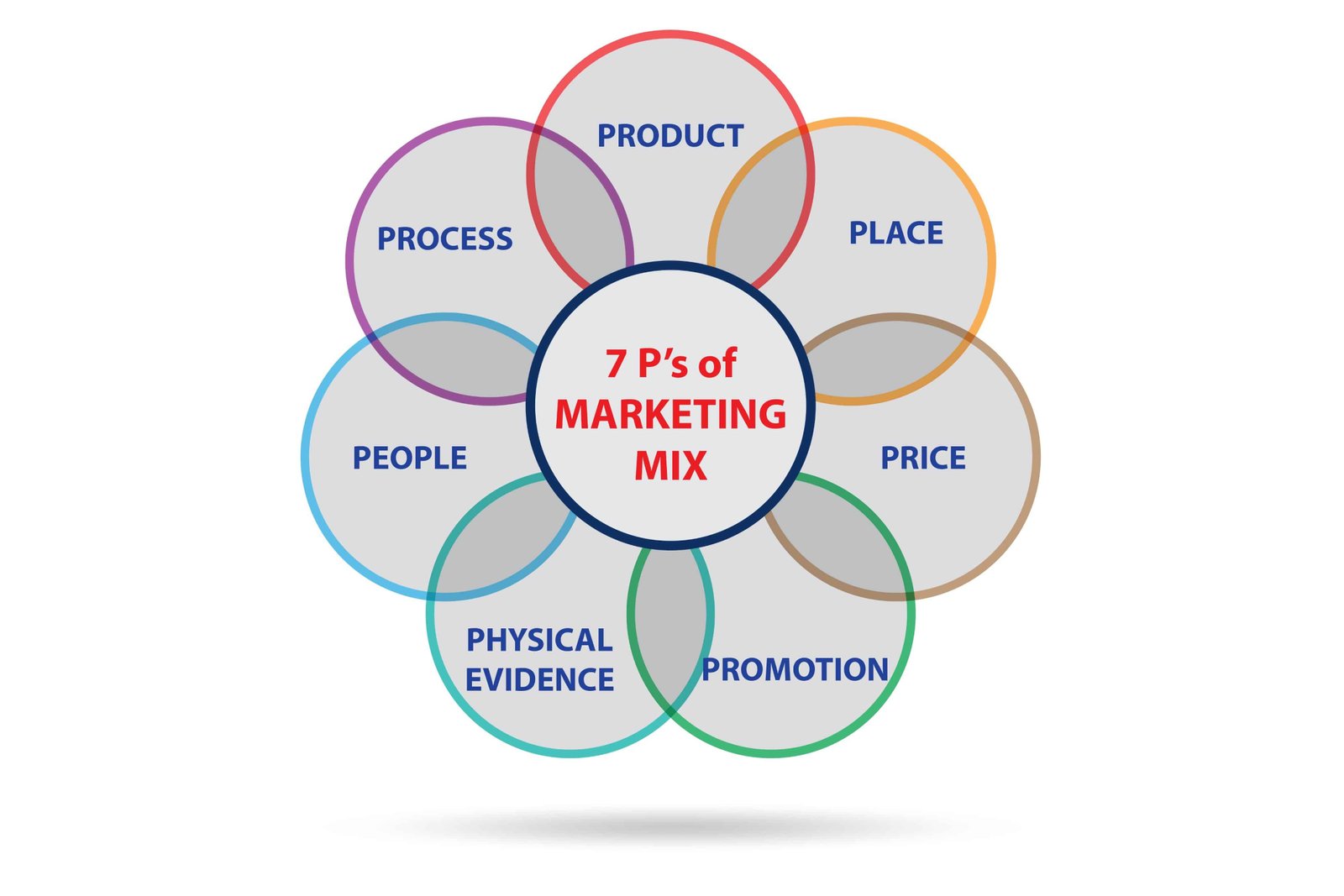
Used properly, the 7Ps help you:
-
Design offers that fit your audience.
-
Communicate clearly and consistently across channels.
-
Deliver an experience that keeps customers coming back.
Let’s break them down.
1. Product: Your Core Solution
Your product is not just what you sell; it is the solution you bring to someone’s problem or desire. It includes quality, features, packaging, branding, and after-sales support.
Key questions to ask:
-
What problem does this solve and for whom?
-
How is it different or better than existing alternatives?
-
Does the design, packaging, and experience match the promise you make?
When your product tightly aligns with customer needs and expectations, every other piece of marketing gets easier.
2. Price: What Your Offer Signals
Price is more than a number; it sends a signal about value, quality, and positioning. People subconsciously judge whether you are budget, mid-range, or premium the moment they see your pricing.
Effective pricing should:
-
Cover costs and deliver profit while still feeling fair to your audience.
-
Match your positioning (e.g., premium brands rarely rely on deep discounts).
-
Use tools like bundles, limited offers, or tiered pricing strategically.
Get pricing wrong and you either scare people away or leave money on the table.
3. Place: Where Customers Find You
“Place” is about where and how customers access your product—physical locations, online stores, marketplaces, distributors, or even social platforms.
A smart approach to place ensures:
-
Your product is available where your audience already spends time.
-
Your online and offline channels feel consistent, not disconnected.
-
Delivery, logistics, or service are convenient enough that buying feels easy.
If you make people work too hard to buy from you, they simply won’t.
4. Promotion: Telling Your Story Clearly
Promotion is how you spread the word—ads, content, social media, PR, events, email, partnerships, and more. The goal is not noise; it is clarity and relevance.
Strong promotion should:
-
Grab attention quickly with benefits that matter to your audience.
-
Explain how you solve their problem better or differently.
-
Nudge people toward a clear next step, like signing up, booking, or purchasing.
Consistent, targeted messaging across channels beats one-off, random campaigns every time.
5. People: The Human Side of Your Brand
People include everyone who represents your brand—sales reps, support teams, frontline staff, freelancers, and even influencers or ambassadors.
Your people shape:
-
How trusted, respected, and understood customers feel.
-
Whether issues are handled with empathy and speed.
-
How well your brand values show up in real interactions.
Training, culture, and communication are just as important as scripts or processes here.
6. Process: How You Deliver Consistently
Process is the behind-the-scenes system that delivers your product or service smoothly—from first touch to final delivery and beyond.
Good processes help you:
-
Reduce errors, delays, and customer frustration.
-
Create a predictable, reliable experience every time.
-
Scale without everything breaking under pressure.
When your process is clunky, no amount of great branding will save the experience.
7. Physical Evidence: Tangible Proof You Are Real
Physical evidence includes all the tangible or visual cues that reassure customers your brand is real and trustworthy—packaging, store design, website, documents, receipts, uniforms, and more.
These touchpoints:
-
Reinforce your positioning and professionalism.
-
Influence how “premium,” “reliable,” or “modern” you seem.
-
Help people feel safer about paying you or committing long term.
Even in a digital world, these details quietly shape perceptions.
Traditional vs Digital Marketing Fundamentals
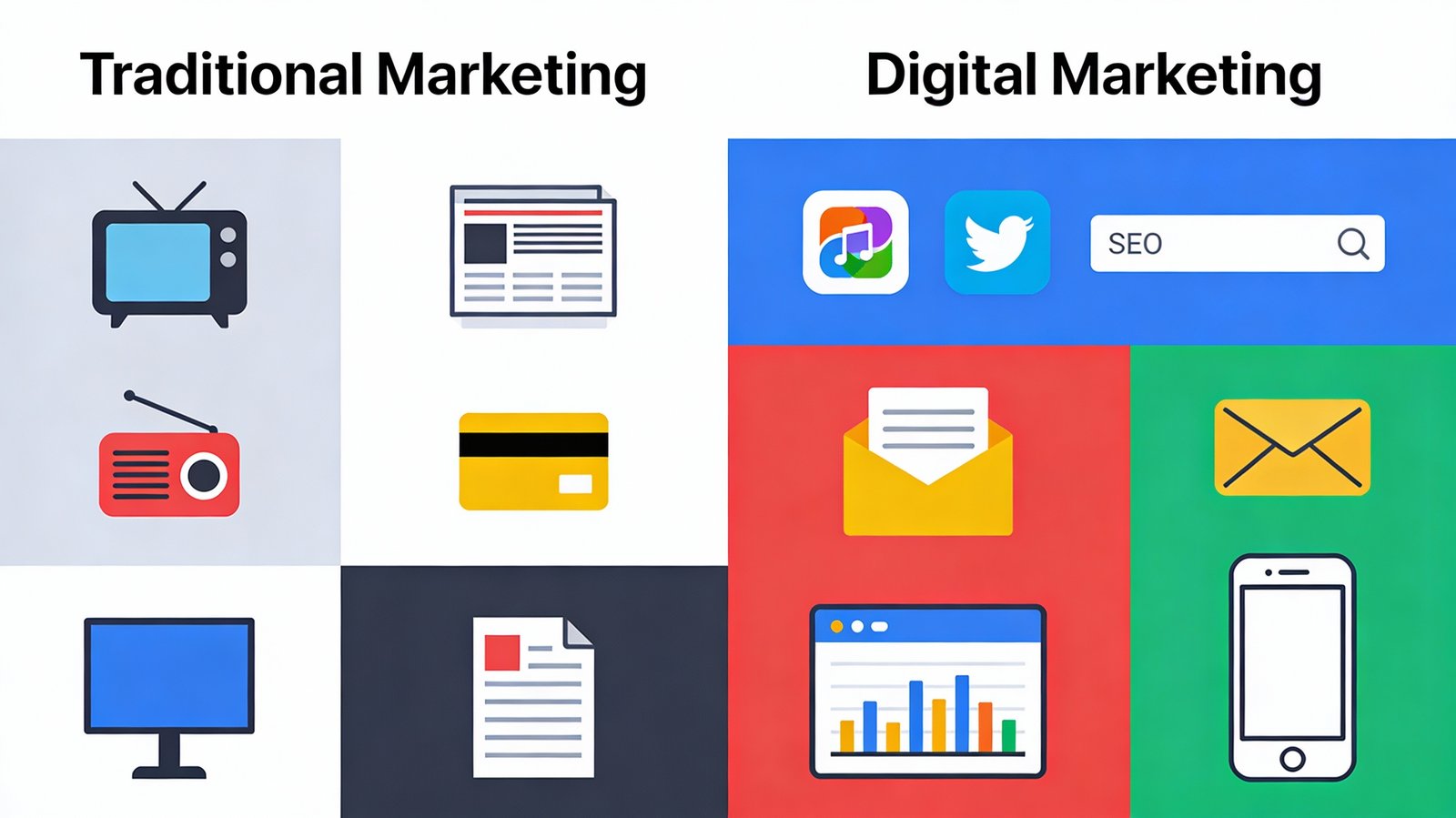
Both traditional (often manual) and digital marketing aim to do the same thing: reach people with the right message. They just use different tools and have different strengths.
Here is a quick view of how they stack up:
| Aspect | Traditional / Manual Marketing | Digital Marketing |
|---|---|---|
| Channels | Print, TV, radio, outdoor, events, flyers, cold calls | Websites, search, social media, email, online ads |
| Targeting | Broad, less personalized | Highly targeted and segmented by data |
| Cost structure | Often higher fixed costs (printing, media buys) | More flexible, scalable budgets |
| Measurement | Harder to track performance precisely | Real-time analytics on clicks, leads, and sales |
| Interaction | Mostly one-way communication | Two-way, interactive engagement |
| Reach | Local or regional focus | Global, always-on presence |
Traditional methods still shine for local presence, physical events, and communities, while digital channels excel in precise targeting, optimization, and measurable ROI.
Manual (Offline) Marketing: Strengths and Limits
Manual or offline Marketing Fundamentals taps into physical, human, and face-to-face interactions.
Typical examples include:
-
Print ads, brochures, and posters.
-
Events, trade shows, and in-person networking.
-
Door-to-door sales or cold calling.
Pros:
-
Builds strong personal connections and trust in local markets.
-
Tangible materials can leave a lasting impression.
-
Useful where internet access or digital familiarity is limited.
Cons:
-
More time-consuming and labor intensive.
-
Harder to measure and optimize quickly.
-
Usually higher cost per contact than digital channels.
Digital Marketing: The Modern Growth Engine
Digital marketing uses online channels—websites, search engines, social media, email, apps, and digital ads—to reach and convert customers.
Its key advantages:
-
Real-time data on what works, from impressions to revenue.
-
Precise targeting based on interests, behavior, location, and more.
-
Ability to test, refine, and scale campaigns quickly.
Modern brands rely on digital not just for visibility, but for trust-building, customer education, and continuous optimization.
Core Components of Digital Marketing Fundamentals
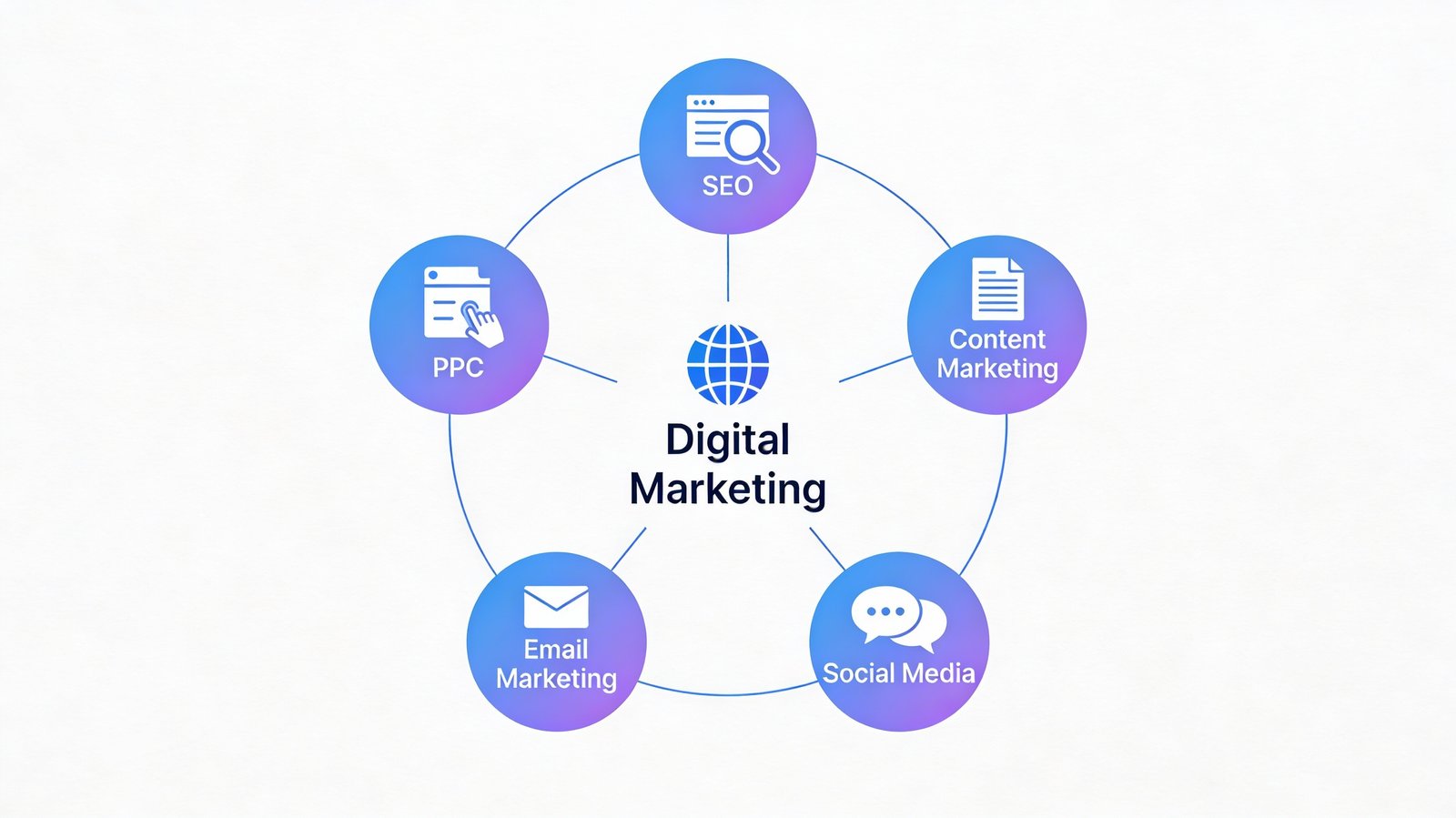
Digital Marketing Fundamentals is not one thing; it is an ecosystem of channels that work best when they support each other.
Here are the key pillars.
1. Search Engine Optimization (SEO)
SEO is about helping search engines understand your site and rewarding you with visibility when people search for what you offer.
Done well, SEO:
-
Increases organic traffic and reduces reliance on paid ads over time.
-
Builds authority by matching helpful content to user intent.
-
Drives compounding results as your content library grows.
Core best practices include smart keyword research, clean site structure, fast loading pages, and high-quality content that actually answers questions.
2. Content Marketing
Content marketing creates and shares valuable content—blogs, videos, guides, podcasts, infographics, webinars—to attract and nurture your audience.
Its main benefits:
-
Educates potential customers and moves them along the buyer journey.
-
Positions your brand as a trusted expert in your niche.
-
Fuels other channels like SEO, email, and social media.
The secret is consistency and usefulness: solve real problems, and people will keep coming back.
3. Social Media Marketing
Social media Marketing Fundamentalsuses platforms like Facebook, Instagram, LinkedIn, X, TikTok, and others to connect with your audience.
It helps you:
-
Build brand awareness and personality.
-
Interact directly via comments, messages, and communities.
-
Amplify campaigns with both organic and paid reach.
Focus on the platforms where your audience actually spends time, then share content tailored to the culture of that platform.
4. Email Marketing
Email remains one of the highest ROI channels because it gives you a direct line to your audience.
Effective email strategies:
-
Nurture leads with helpful sequences instead of just promotions.
-
Segment lists so subscribers receive relevant content.
-
Test subject lines, send times, and formats to improve engagement.
Treat inbox access as a privilege, not a right, and always deliver value.
5. Pay-Per-Click (PPC) Advertising
PPC ads show on search engines or other sites, and you pay only when someone clicks.
PPC is especially useful for:
-
Immediate visibility for high-intent searches.
-
Testing offers, landing pages, and messages quickly.
-
Targeting specific demographics, interests, or behaviors.
The key is tight keyword targeting, compelling ad copy, and landing pages that actually deliver on the promise of the ad.
6. Affiliate and Influencer Marketing
Marketing Fundamentals, you partner with affiliates or influencers who promote your brand to their audiences in exchange for a commission or fee.
Why it works:
-
Leverages trusted voices and existing communities.
-
Expands reach into new, pre-qualified audiences.
-
Often operates on performance-based models, lowering upfront risk.
Choosing partners who align with your values is crucial to avoid damaging trust.
7. Mobile Marketing
Mobile marketing focuses on reaching people on smartphones and tablets through responsive sites, apps, SMS, push notifications, and mobile ads.
It enables you to:
-
Stay present in the moments people actually make decisions on the go.
-
Use location and behavior-based triggers for more relevant messages.
-
Offer frictionless experiences with mobile-optimized journeys.
If your site or emails are hard to use on mobile, you are losing conversions daily.
Must-Read Marketing Books for Stronger Fundamentals
A few classic books keep showing up on marketer shelves because the principles still work, even as channels change.
Some stand-out titles include:
-
“Influence: The Psychology of Persuasion” by Robert Cialdini
Explores why people say yes using principles like reciprocity, social proof, and authority, helping you design ethical, persuasive campaigns. -
“Contagious: How to Build Word of Mouth in the Digital Age” by Jonah Berger
Breaks down what makes ideas and products go viral, offering practical frameworks for creating shareable content and experiences. -
“This Is Marketing” by Seth Godin
Emphasizes empathy, storytelling, and serving a specific audience rather than chasing everyone, reinforcing long-term brand building over gimmicks.
These books pair perfectly with hands-on experimentation.
Planning a Strategy Using Marketing Fundamentals
A strong digital Marketing Fundamentals strategy is intentional, measurable, and tied directly to business goals.
Key steps include:
-
Set SMART goals
Define goals that are Specific, Measurable, Achievable, Relevant, and Time-bound—like “Increase organic traffic by 20% in six months” or “Generate 500 qualified leads this quarter.” -
Define your target audience and buyer personas
Use research to segment by demographics, psychographics, behavior, and needs, then build detailed personas to guide messaging, offers, and channel selection. -
Allocate your budget wisely
Distribute spend based on potential ROI, using a mix of paid ads, content, SEO, social, and analytics tools, and adjust based on performance data. -
Integrate multiple channels
Align SEO, PPC, social, email, and content so they support the same core messages, offers, and goals, instead of acting as siloed efforts. -
Monitor and optimize continuously
Track KPIs like traffic, conversion rates, cost per acquisition, and lifetime value, then refine campaigns, creative, and targeting.
A good strategy is a living system, not a static document.
Key Trends Shaping Digital Marketing
Marketing Fundamentals do not change, but the tools around them do. Right now, a few big trends are reshaping how strategies are executed.
Important shifts include:
-
AI and automation
AI tools streamline tasks like content generation, ad optimization, segmentation, and predictive analytics, improving efficiency and personalization. -
Deep personalization
Brands are tailoring experiences in real time—dynamic website content, personalized emails, and product recommendations are becoming standard expectations. -
Video and short-form content
Short videos on TikTok, Instagram Reels, and YouTube Shorts continue to drive engagement, storytelling, and brand discovery. -
Voice search and conversational experiences
Voice assistants and chatbots are changing how people search and interact, pushing brands to adapt content and build conversational journeys.
Keeping an eye on these makes it easier to apply fundamentals in a way that feels modern.
Creating Your Marketing Strategy Step by Step
Think of your strategy as a chain—each link supports the next. If one link is weak, the whole system suffers.
A practical flow looks like this:
-
Define clear, measurable business and marketing goals.
-
Research and deeply understand your target audience.
-
Analyze competitors and market trends for opportunities and threats.
-
Craft a focused value proposition and core messaging.
-
Choose marketing channels that match your audience and goals.
-
Plan campaigns, assign responsibilities, and build timelines.
-
Track performance, learn from the data, and optimize continuously.
Follow this sequence and your marketing becomes less reactive and more predictable.
Common Strategy Mistakes to Avoid
Even smart brands fall into avoidable traps that limit their results.
Some of the biggest mistakes include:
-
Skipping market research
Basing strategy on assumptions leads to weak targeting, irrelevant messaging, and wasted spend. -
Ignoring customer feedback
Reviews, support tickets, and social comments are a goldmine of insight; ignoring them keeps you repeating the same problems. -
Chasing only short-term wins
Obsessing over quick sales or viral spikes without building reputation and loyalty weakens your long-term position.
Avoiding these pitfalls saves time, money, and frustration.
Turning Fundamentals into Long-Term Growth
Marketing fundamentals are not just theory; they are the engine behind sustainable growth. When you understand your audience, craft real value, price and position it wisely, choose the right channels, and execute with consistent processes, growth stops feeling random and starts feeling repeatable.
Each element—research, the 7Ps, digital tactics, offline touchpoints, and optimization—works together like gears in a machine. With clarity and steady action, that machine keeps turning, compounding your results and building a brand that can withstand trends, competitors, and market shocks.
conclusion
Marketing Fundamentals success does not come from chasing every new trend; it comes from mastering the fundamentals and applying them consistently. When you truly understand your audience, design offers that solve real problems, and use frameworks like the 7Ps to shape every decision, your strategy becomes far more predictable and powerful. Combine that foundation with smart digital and traditional channels, continual research, and a willingness to test and adapt, and you build a growth engine that can survive algorithm changes, new competitors, and shifting customer expectations.