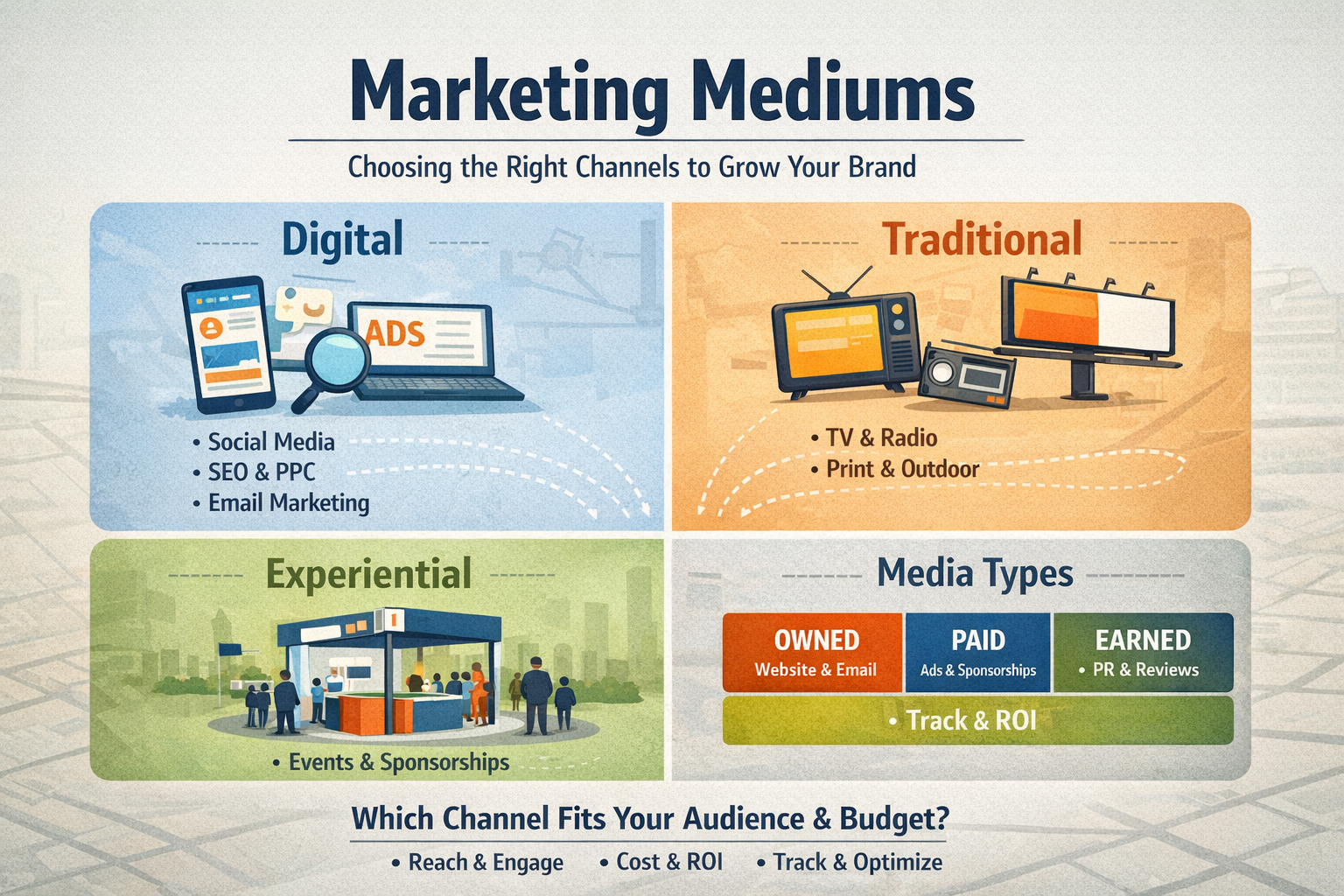
Marketing Mediums, When we say “marketing medium,” we’re really talking about the channel you use to deliver your message to your audience. Think of it as the road your brand travels on to reach potential customers.
Some common marketing mediums include:
-
Social media platforms
-
Search engines (organic and paid)
-
Email
-
TV, radio, print
-
Outdoor (billboards, transit ads, signage)
-
Events and sponsorships
-
Influencer and affiliate networks
Each medium has its own rules, strengths, and weaknesses. The trick is not to use all of them, but to find the mix that matches your audience, your offer, and your budget.
Why your choice of medium matters
You can have the best offer in the world, but if you shout it in the wrong place, nobody hears it. That’s the core problem of a poor marketing-medium strategy.
Your choice affects:
-
Who actually sees your message
-
How much you pay to reach them
-
How persuasive the context feels
-
How fast you get feedback and data
It like choosing between a whisper in someone’s ear, a radio jingle in rush hour, or a giant billboard over a highway. Same brand, totally different impact.
Main types of marketing mediums
Let’s break the main mediums into groups so they’re easier to compare and combine.
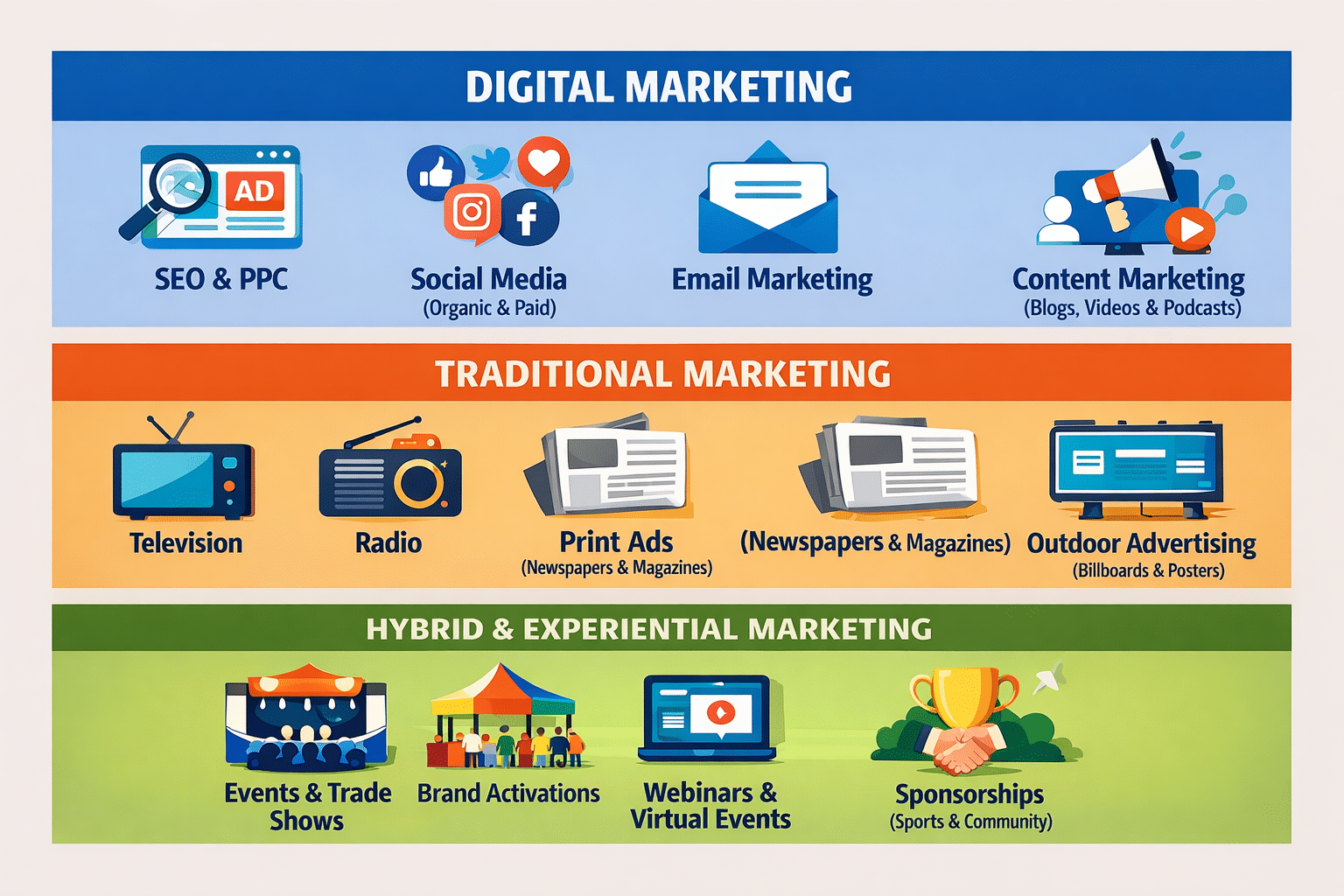
Digital marketing mediums
Digital channels are where most brands now spend the bulk of their budget.
Key digital mediums:
-
Search (SEO and PPC)
-
Email marketing
-
Content marketing (blogs, videos, podcasts, guides)
-
Display advertising and programmatic
-
Affiliate and influencer marketing
These channels are measurable, relatively flexible, and can be optimized in near real-time. They’re also crowded, so creativity and clarity are your best friends.
Traditional marketing mediums
Traditional doesn’t mean outdated. It means offline and usually more mass-reach.
Examples:
-
Television
-
Radio
-
Print (newspapers, magazines, flyers)
-
Outdoor (billboards, posters, transit)
Traditional mediums are powerful for awareness, credibility, and reaching demographics that may not scroll all day. They tend to be less precise and harder to track but can still deliver massive impact.
Hybrid and experiential mediums
Some mediums sit between digital and physical, or rely heavily on experience:
-
Events and trade shows
-
Brand activations
-
Webinars and virtual events
-
Sponsorships (sports, culture, communities)
These are about depth of connection as much as breadth of reach. Think relationship-building, not just impressions.
Owned, paid, and earned media
Another useful way to look at marketing mediums is through the lens of ownership.
-
Owned media: channels you fully control, like your website, app, email list, or blog.
-
Paid media: channels you pay to access, like ads on Google, Meta, TV, or billboards.
-
Earned media: exposure you “earn” when others talk about you, like PR, reviews, user-generated content, and word-of-mouth.
Most smart strategies blend all three: you drive traffic via paid, convert and nurture via owned, and amplify via earned.
Digital marketing mediums in detail
Let’s zoom in on the digital side, because it’s where nuance really matters.
Search: SEO and PPC
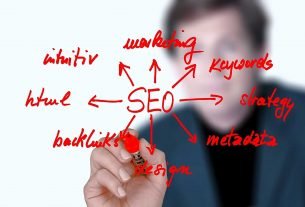
Search is intent-driven: people are literally telling you what they want by typing it into Google.
-
SEO (search engine optimization): You optimize your site and content so you appear in organic results. Slower to build, but incredibly cost-efficient long term.
-
PPC (pay-per-click): You pay to appear in search results instantly, bidding on keywords. Fast to launch, highly measurable, but costs can climb quickly.
Example: A local dentist might use SEO to rank for “dentist in Ahmedabad” while using PPC for “emergency dentist near me” to capture high-intent searchers immediately.
Social media: organic and paid
Social platforms are like crowded city squares where everyone is talking at once—fun, noisy, and full of opportunity.
-
Organic social: Content you post for free, to build community, authority, and brand personality.
-
Paid social: Ads you run to target specific audiences by interest, behavior, or demographics.
Great for: visual brands, stories, community engagement, and rapid testing of ideas (you get feedback in likes, shares, comments, and DMs).
Email marketing
Your email list is one of your most valuable owned assets. Algorithms don’t control it; you do.
Email works for:
-
Nurturing leads over time
-
Sharing offers and launches
-
Onboarding new customers
-
Retention and upsell campaigns
Think of email as a direct line into someone’s personal space—use it to help, not just sell.
Content marketing
Content is the engine that powers many other channels.
Forms include:
-
Blog posts and guides
-
Videos and live streams
-
Podcasts
-
Infographics and downloads
Strong content attracts attention, builds trust, and fuels SEO, social media, and email. It’s the story you tell, at scale.
Display, affiliate, and influencer marketing
-
Display ads: Banner and native ads across websites and apps, often bought programmatically.
-
Affiliate marketing: Partners promote you for a commission on sales or leads.
-
Influencer marketing: Creators with audiences showcase your brand to their followers.
These channels leverage other people’s real estate or reputation to expand your reach.
Traditional marketing mediums in detail
Despite the digital boom, traditional media can still be a powerful lever—especially for credibility and mass reach.
TV and radio
-
TV: High-impact, sight-and-sound storytelling, great for mainstream awareness and brand building.
-
Radio: Strong for frequency and local reach, especially drive-time slots.
These mediums work well when you have a clear message, broad audience, and the budget to sustain repetition.
Print and outdoor
-
Print: Magazines, newspapers, brochures—often used to target niche or local audiences.
-
Outdoor: Billboards, transit ads, digital screens in public spaces.
They’re like giant, unskippable posts in the real world. Great for simple, memorable messages and brand presence.
Experiential and event-based marketing
Experiential marketing focuses on creating real-world (or virtual) experiences that people remember and talk about.
Examples:
-
Pop-up stores
-
Live demos and roadshows
-
Trade show booths
-
Webinars, workshops, and conferences
These mediums are particularly powerful in B2B and high-consideration purchases, where human connection moves the needle.
How to choose the right marketing medium
Choosing a marketing medium is less about trends and more about fit. Ask yourself a few key questions:
-
Who exactly am I trying to reach?
-
Where do they already spend their time and attention?
-
What stage of the customer journey am I targeting (awareness, consideration, conversion, retention)?
-
What’s my budget and timeline?
-
How will I measure success?
A B2B SaaS startup and a fashion D2C brand might both “do social,” but the right mix, tone, and expectations will look very different.
Matching mediums to the customer journey
Different mediums shine at different stages of the funnel.
-
Awareness: TV, YouTube, social ads, outdoor, PR, influencers
-
Consideration: SEO content, comparison guides, webinars, case studies, email sequences
-
Conversion: PPC search ads, retargeting, product pages, limited-time email offers
-
Retention: Email, SMS, loyalty programs, community groups, support content
Treat your mediums like a relay team: each one runs its leg, then passes the baton to the next.
Measuring and optimizing each medium
If you can’t measure it, you can’t improve it. Each medium has its own metrics and benchmarks.
Examples:
-
Search: impressions, click-through rate, cost per click, conversions
-
Social: reach, engagement rate, click-throughs, cost per result
-
Email: open rate, click rate, unsubscribe rate, revenue per send
-
TV/outdoor: reach estimates, frequency, brand-lift studies, direct-response spikes
Use clear tracking (UTMs, pixels, promo codes, dedicated URLs) so you know which medium actually moved the needle.
Combining marketing mediums for maximum impact
The real magic happens when your mediums work together like an integrated system, not isolated tactics.
For example:
-
A TV or YouTube campaign builds broad awareness.
-
Search and social ads catch people who look you up afterward.
-
Your website and content answer their questions.
-
Email and retargeting bring them back to buy.
-
Great service and newsletters turn them into advocates who spread word-of-mouth.
You’re not choosing one “silver bullet” medium; you’re designing a connected ecosystem.
Common mistakes when picking mediums
Many brands don’t get burned by bad mediums, but by using decent mediums in the wrong way.
Frequent mistakes:
-
Chasing trends (e.g., every new platform) without strategy
-
Ignoring where the actual audience spends time
-
Spreading budget too thin across too many channels
-
Expecting brand-awareness channels to drive direct conversions overnight
-
Failing to track properly and optimize over time
Avoid these, and you’re already ahead of a big chunk of the market.
Conclusion
Your marketing medium is the bridge between your brand and your buyer. Choose the wrong bridge and your message falls into the water. Choose the right ones—and connect them intelligently—and you create a smooth, repeatable path from stranger to customer to fan.
You don’t need every channel. You need the right channels, tuned to your audience, goals, and resources, and constantly refined by data and real-world feedback.
If you think of your marketing as a conversation, your medium is the room you’re standing in. Pick the room where your audience already hangs out, speak in a voice they trust, and keep showing up consistently. Do that, and the mediums stop feeling like a mystery—and start working like a growth engine.