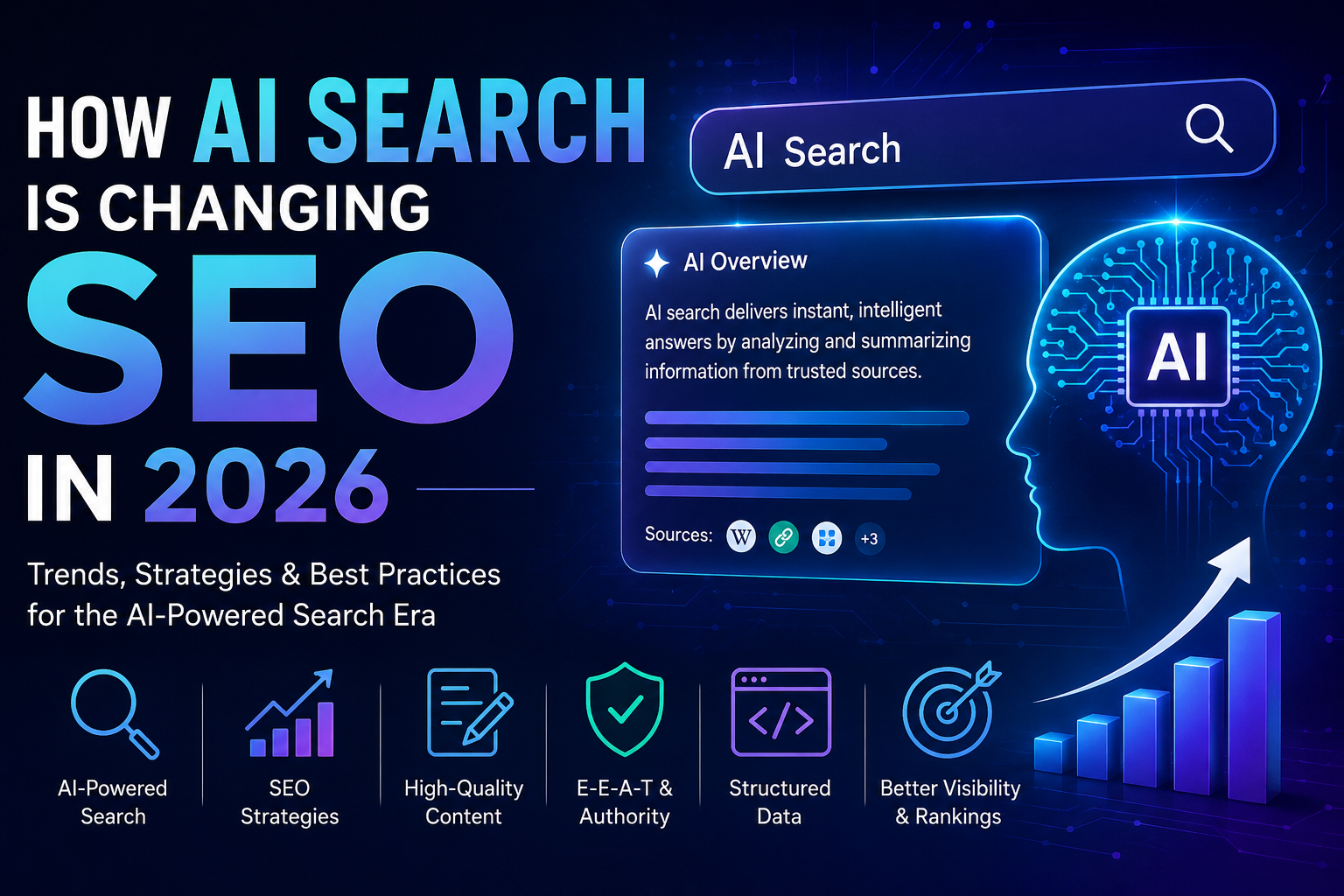
AI Search SEO, Artificial intelligence has transformed the way people search for information online. In 2026, search engines are no longer limited to displaying a list of blue links. Instead, AI-powered search experiences provide direct answers, personalized recommendations, conversational interactions, and summarized information. This evolution has significantly changed how businesses, marketers, and website owners approach Search Engine Optimization (SEO).
This article explores how AI search is reshaping SEO in 2026 and what businesses should do to remain visible in an AI-first search environment.
What Is AI Search?
AI search combines traditional search engine technology with advanced artificial intelligence and large language models (LLMs). Instead of returning only webpages, AI search engines generate complete answers by analyzing information from multiple trusted sources.
Unlike traditional search, AI-powered systems can:
- Understand natural language questions
- Provide conversational responses
- Summarize multiple sources
- Recommend products and services
- Answer follow-up questions
- Personalize search experiences
This creates a faster and more user-friendly search experience while changing how websites earn visibility.
Why SEO Is Different in 2026
Traditional SEO focused on:
- Keyword density
- Backlinks
- Meta tags
- PageRank
- Search rankings
Modern AI SEO focuses on:
- Topical authority
- Content quality
- User experience
- Structured data
- Brand trust
- Entity optimization
- E-E-A-T (Experience, Expertise, Authoritativeness, and Trustworthiness)
Ranking #1 still matters, but appearing as a trusted source within AI-generated answers has become equally important.
AI Overviews Are Reducing Traditional Clicks
AI Search SEO, Google’s AI Overviews provide summarized answers directly within search results.
Instead of visiting several websites, users often receive:
- Step-by-step instructions
- Product recommendations
- Comparisons
- Definitions
- Buying advice
As a result, many informational searches end without users clicking through to individual websites.
This phenomenon is often called zero-click search.
Website owners should not panic. Instead, they should optimize content so AI systems choose their pages as trusted reference sources.
Content Quality Matters More Than Ever
In 2026, publishing dozens of low-quality articles no longer works.
AI search engines evaluate:
- Original insights
- Helpful explanations
- Real-world experience
- Comprehensive coverage
- Accurate information
- Expert opinions
Content created only to manipulate rankings is increasingly ignored.
Instead of writing for algorithms, successful websites write for users while maintaining technical SEO best practices.
Topical Authority Is Becoming the New Ranking Factor
Search engines now evaluate entire websites instead of individual pages.
For example:
If your website publishes 100 well-written articles about SEO, Google is more likely to recognize your domain as an authority on digital marketing.
Instead of creating unrelated content, businesses should build topic clusters covering every aspect of their niche.
Example for an SEO website:
- Keyword Research Guide
- Technical SEO Checklist
- Local SEO Tips
- AI SEO Strategies
- Link Building
- Core Web Vitals
- Content Optimization
- Schema Markup
Comprehensive topical coverage strengthens authority and improves visibility in AI-generated search results.
User Intent Has Become the Core of SEO
AI Search SEO, Keywords still matter, but understanding user intent matters even more.
AI search engines understand:
- Why users ask questions
- What information they need
- Their search history
- Context
- Location
- Follow-up questions
For example:
Instead of optimizing only for:
“Best laptops”
Create content answering:
- Best laptops for students
- Best laptops under $1000
- Best laptops for programming
- Best laptops for video editing
- Buying guide
- Pros and cons
- Frequently asked questions
Matching search intent improves visibility across AI-powered search platforms.
Conversational Search Is Growing
People increasingly search using conversational language.
Instead of typing:
SEO tips
Users now ask:
What are the best SEO strategies for a small business in 2026?
AI understands complete questions.
Content should therefore include:
- FAQs
- Natural language headings
- Question-based subheadings
- Detailed answers
This improves discoverability in conversational search.
E-E-A-T Is More Important Than Ever
Google continues emphasizing E-E-A-T:
- Experience
- Expertise
- Authoritativeness
- Trustworthiness
AI systems prioritize content from reliable publishers.
Ways to improve E-E-A-T include:
- Publishing author biographies
- Citing credible sources
- Including original research
- Sharing case studies
- Providing accurate statistics
- Updating content regularly
These trust signals help AI systems identify high-quality information.
Structured Data Helps AI Understand Content
AI Search SEO, Schema markup has become even more valuable.
Structured data helps AI understand:
- Articles
- Products
- FAQs
- Organizations
- Reviews
- Recipes
- Events
Proper schema increases the likelihood of appearing in rich results and AI-generated summaries.
Popular schema types include:
- Article Schema
- FAQ Schema
- Product Schema
- Organization Schema
- Breadcrumb Schema
Brand Mentions Matter More Than Links Alone
Backlinks remain important, but brand recognition has become equally valuable.
AI models analyze:
- Brand mentions
- Online reputation
- Expert citations
- Industry discussions
- Reviews
- Social signals
Businesses should build authority by:
- Publishing research
- Guest posting
- Appearing in interviews
- Participating in podcasts
- Earning media coverage
A trusted brand is more likely to be referenced by AI search systems.
User Experience Influences AI Rankings
Poor user experience negatively affects SEO.
Important UX factors include:
- Fast loading pages
- Mobile responsiveness
- Easy navigation
- Clear headings
- Readable fonts
- Minimal intrusive ads
- Secure HTTPS connections
Visitors should quickly find the information they need without unnecessary distractions.
Multimedia Content Is Becoming Essential
AI Search SEO, AI search increasingly indexes multiple content formats.
High-performing pages often include:
- Images
- Infographics
- Videos
- Charts
- Interactive tools
- Podcasts
Rich media improves engagement and provides additional context for AI systems, making content more likely to be surfaced in search results.
Content Freshness Is Increasingly Important
AI models and search engines favor recently updated information, especially in fast-changing industries.
Best practices include:
- Refresh statistics
- Update screenshots
- Improve outdated advice
- Add new sections
- Remove obsolete information
Regular updates signal that content remains relevant and trustworthy.
Technical SEO Still Matters
Although AI has transformed search, technical SEO remains essential.
Important technical factors include:
- XML sitemaps
- Robots.txt optimization
- Crawlability
- Internal linking
- Canonical URLs
- Core Web Vitals
- HTTPS security
- Clean site architecture
Without a technically sound website, even excellent content may struggle to achieve maximum visibility.
Optimizing for AI Search Platforms
Businesses should expand beyond Google and optimize for multiple AI-powered search experiences.
These include:
- Google AI Overviews
- ChatGPT Search
- Microsoft Copilot
- Perplexity AI
- Claude
- Gemini
The best approach is to publish trustworthy, comprehensive, and well-structured content that AI systems can easily interpret and cite.
Practical SEO Tips for 2026
AI Search SEO, To stay competitive, focus on these strategies:
- Publish original, in-depth content.
- Build topical authority around your niche.
- Optimize for conversational and long-tail queries.
- Improve website speed and mobile usability.
- Use structured data where appropriate.
- Strengthen your brand through digital PR and expert contributions.
- Regularly refresh existing articles with new insights.
- Prioritize E-E-A-T across your entire website.
- Add multimedia elements to improve engagement.
- Monitor AI search trends and adapt your content strategy.
The Future of SEO Beyond 2026
AI search will continue to evolve, making search experiences more personalized, conversational, and predictive. Rather than replacing SEO, AI is redefining it. Success will depend on creating content that genuinely helps users, demonstrates expertise, and earns trust from both people and AI systems.
Businesses that embrace these changes now will be better positioned to maintain visibility, attract qualified traffic, and build lasting authority in an increasingly AI-driven digital landscape.
Read More: Best AI SEO Tools Every Business Should Use in 2026
Conclusion
AI Search SEO, AI search is fundamentally changing SEO in 2026 by shifting the focus from keyword-centric optimization to user-centric, authoritative content. Search engines now reward websites that provide real value, demonstrate expertise, and offer a seamless user experience. While traditional SEO practices such as technical optimization and backlinks remain important, they are no longer sufficient on their own.
The future belongs to websites that combine high-quality content, strong topical authority, structured data, excellent user experience, and trustworthy branding. By adapting to AI-powered search today, businesses can ensure they remain visible and competitive as search continues to evolve.
For a deeper understanding of Google’s guidance on creating helpful, people-first content, refer to the official Google Search Central documentation: https://developers.google.com/search/docs/fundamentals/creating-helpful-content